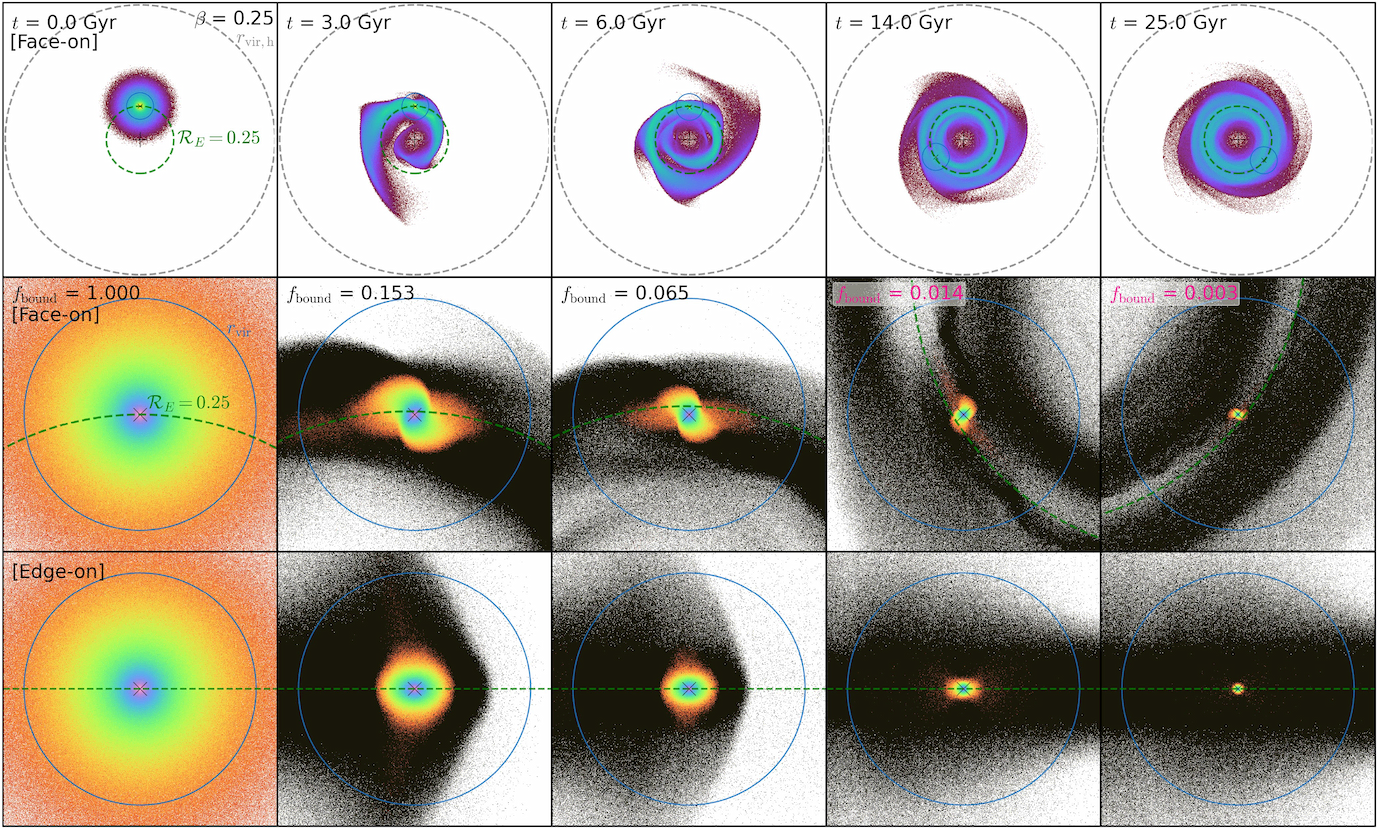
The Tidal Evolution of Anisotropic Subhaloes: a New Pathway to Creating Isotropic and Cored Satellites
In collaboration with Barry Chiang and Prof. Frank van den Bosch (Yale University), we investigate the tidal evolution of anisotropic subhalos using high-resolution N-body simulations with GAMER. The results show that subhalos with strong radial anisotropy at infall experience significant mass loss, leading to cusp–core transformation or even complete tidal disruption, whereas tangentially anisotropic systems are significantly more stable. This tidal evolution drives tidally stripped subhalos toward velocity isotropy, offering a natural explanation for the observed isotropic, cored satellites without invoking baryonic feedback.
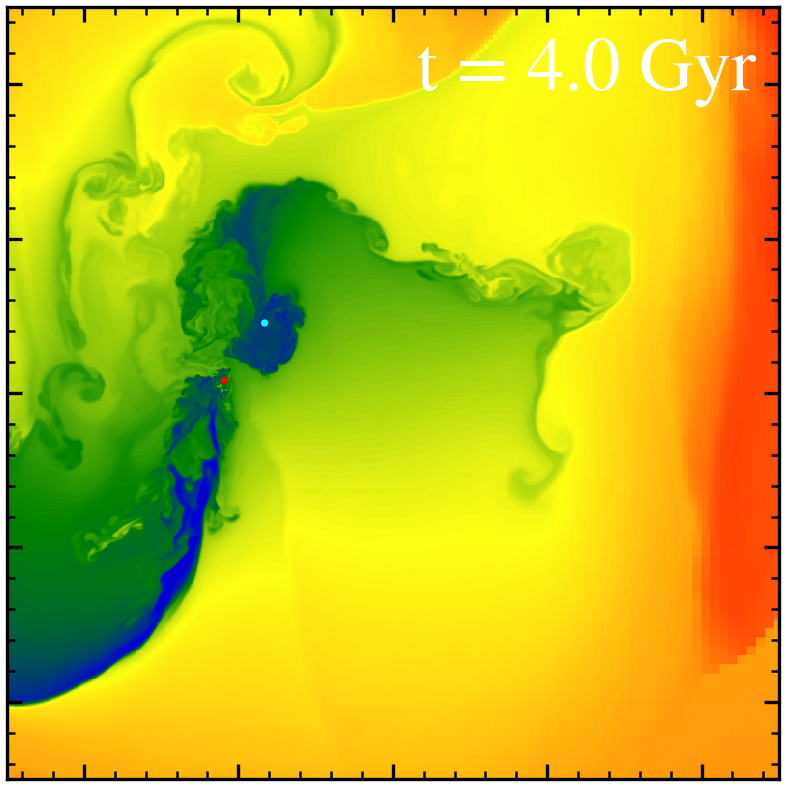
Cool-Core Destruction in Merging Clusters with AGN Feedback and Radiative Cooling
In collaboration with Prof. Karen Yang (NTHU), we simulate binary galaxy cluster mergers, including cold dark matter, hydrodynamics, AGN feedback, and radiative cooling, to investigate the origin of the cool-core and non-cool-core dichotomy in galaxy clusters. The results reveal the critical role of AGN feedback in regulating core properties during mergers and show that cool-core destruction depends sensitively on the merger mass ratio and impact parameter.
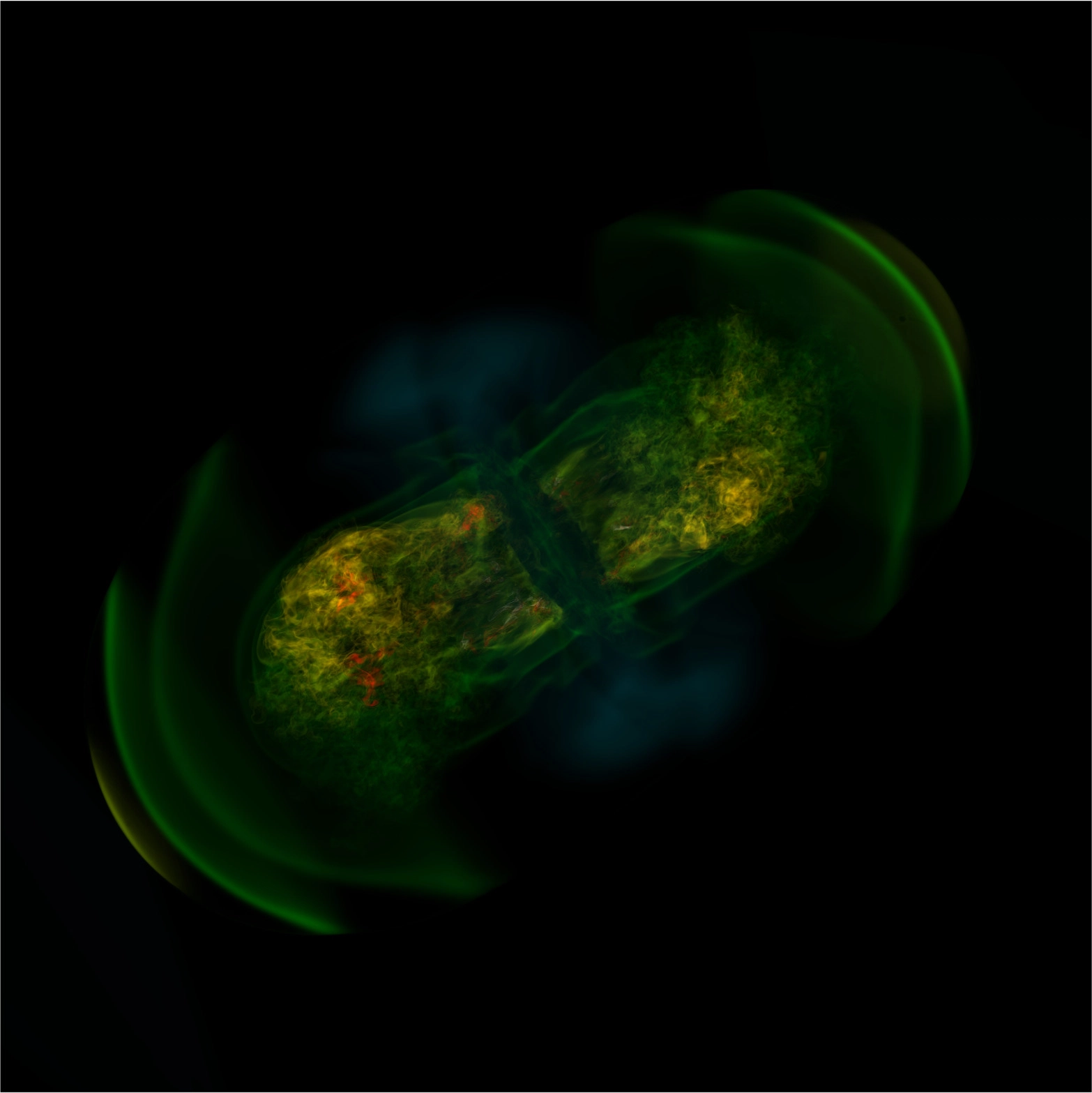
Can the Symmetric Fermi and eROSITA Bubbles Be Produced by Tilted Jets?
In collaboration with Prof. Karen Yang (NTHU), we conduct special relativistic hydrodynamic simulations with cosmic rays to investigate the origin of the Fermi and eROSITA bubbles in the Milky Way. The results demonstrate that oblique AGN jets from the Galactic center, when disrupted by dense clumpy gas in the Galactic disk, can inflate hot buoyant bubbles whose morphology and multi-wavelength signatures closely reproduce the observed symmetric Galactic bubbles.