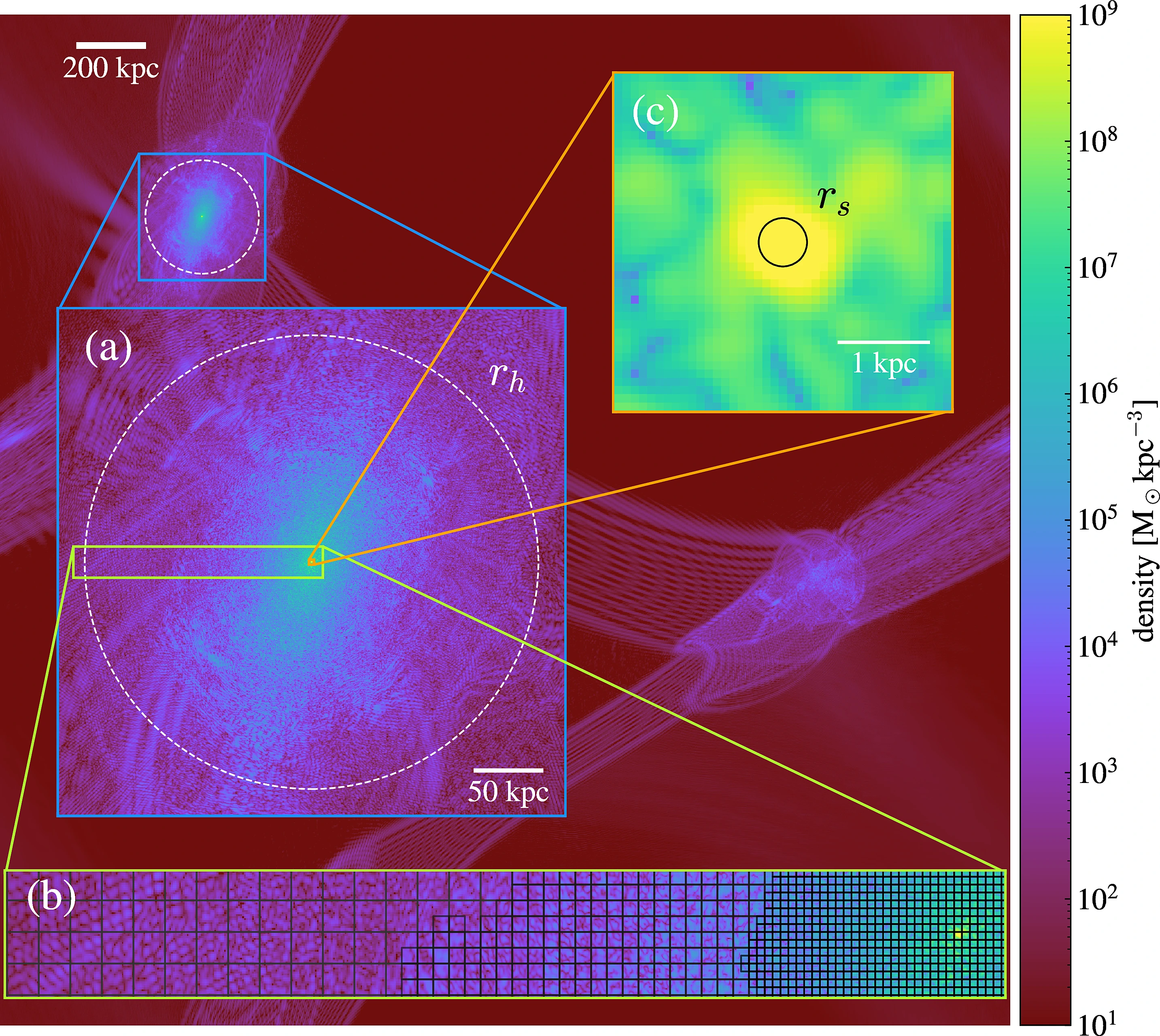
Deciphering the Soliton-Halo Relation in Fuzzy Dark Matter
Using high-resolution fuzzy dark matter (FDM) cosmological simulations spanning wide particle mass and redshift ranges, we show that the degree of non-isothermality in FDM halos is tightly correlated with halo concentration. We further identify energy equipartition in the inner halo and thermal equilibrium between solitons and their surroundings. These results establish a predictive, physically grounded soliton–halo relation that resolves long-standing discrepancies among previous models and enables direct observational constraints on FDM.
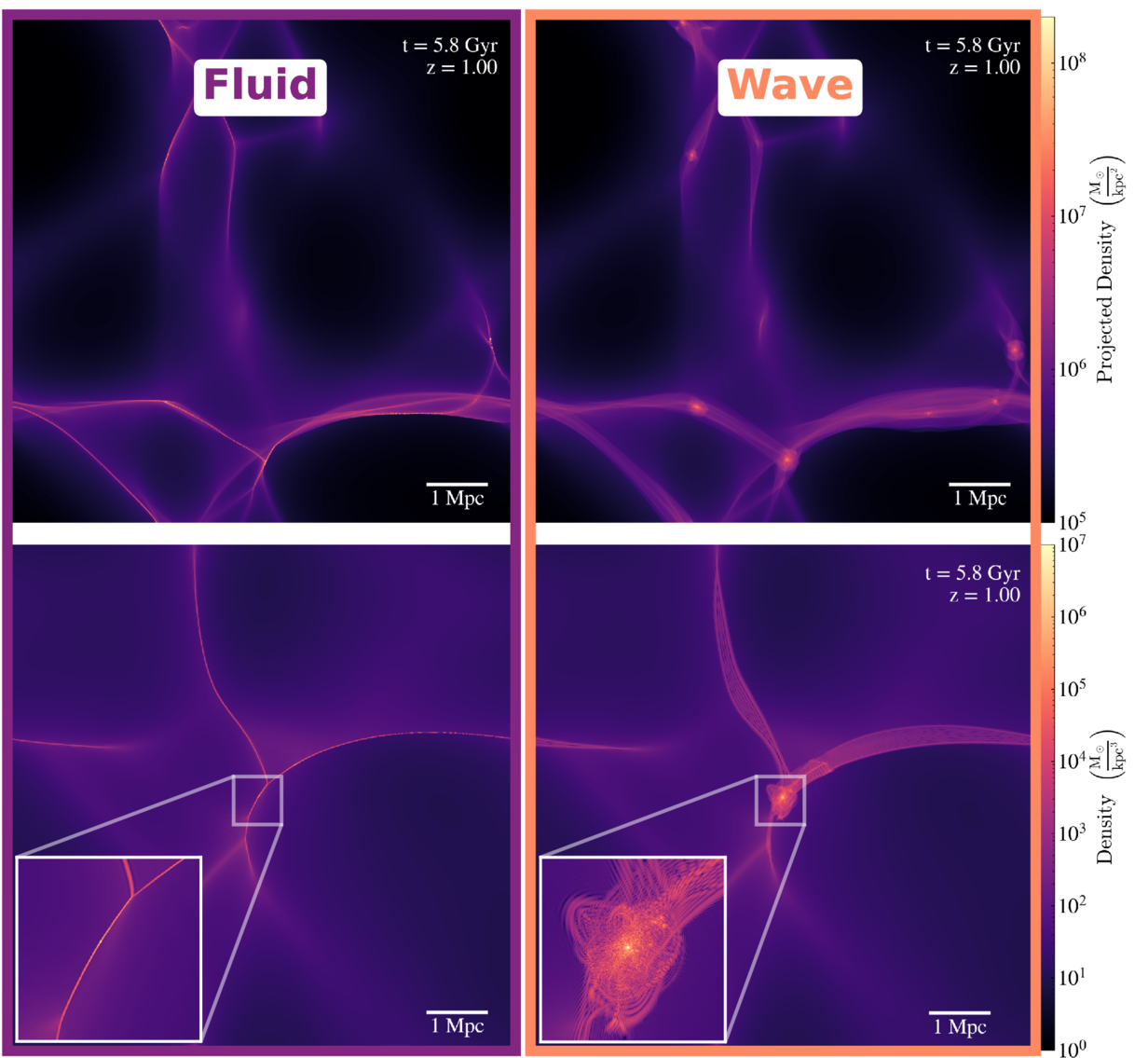
A Hybrid Scheme for Fuzzy Dark Matter Simulations Combining the Schrödinger and Hamilton–Jacobi–Madelung Equations
The short de Broglie wavelength and rapid oscillations associated with high-velocity flows pose a significant challenge for fuzzy dark matter (FDM) simulations, especially for larger FDM particle mass. To address this limitation, we develop a hybrid numerical scheme in GAMER that integrates the wave-based Schrödinger–Poisson formulation with the fluid-based Hamilton–Jacobi–Madelung equations. This approach uses efficient fluid solvers on large, smooth scales while employing wave solvers on refined grids to capture interference patterns and solitonic structures with high accuracy. The wave solver incorporates a novel local pseudo-spectral method based on Fourier continuations with discrete Gram polynomials, together with a robust boundary-matching algorithm that ensures smooth reconstruction of the wave function across fluid–wave interfaces. This hybrid scheme substantially extends the feasible volume of FDM cosmological simulations.
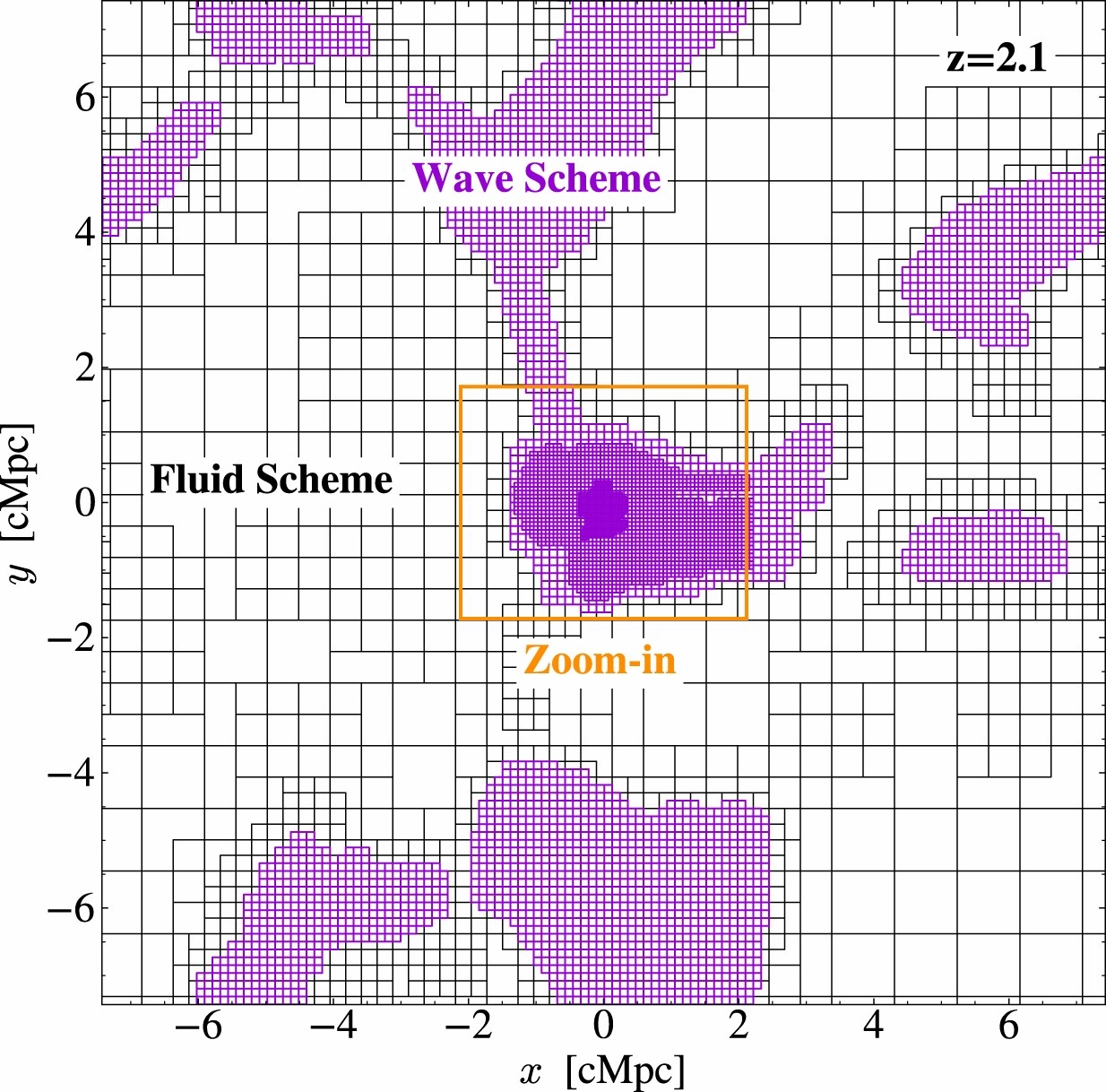
Cosmological Zoom-In Simulation of Fuzzy Dark Matter Down to z = 0: Tidal Evolution of Subhaloes in a Milky Way-Sized Halo
We present the first self-consistent fuzzy dark matter cosmological zoom-in simulation that follows a Milky Way-sized halo and its substructures to redshift zero. The results show that solitonic cores are resilient to tidal interactions, but the universal soliton–halo relation breaks down for tidally stripped subhalos. The simulations also reveal the key roles of granule heating and wave interference in soliton stability, challenging simplified analytic models of subhalo evolution.”
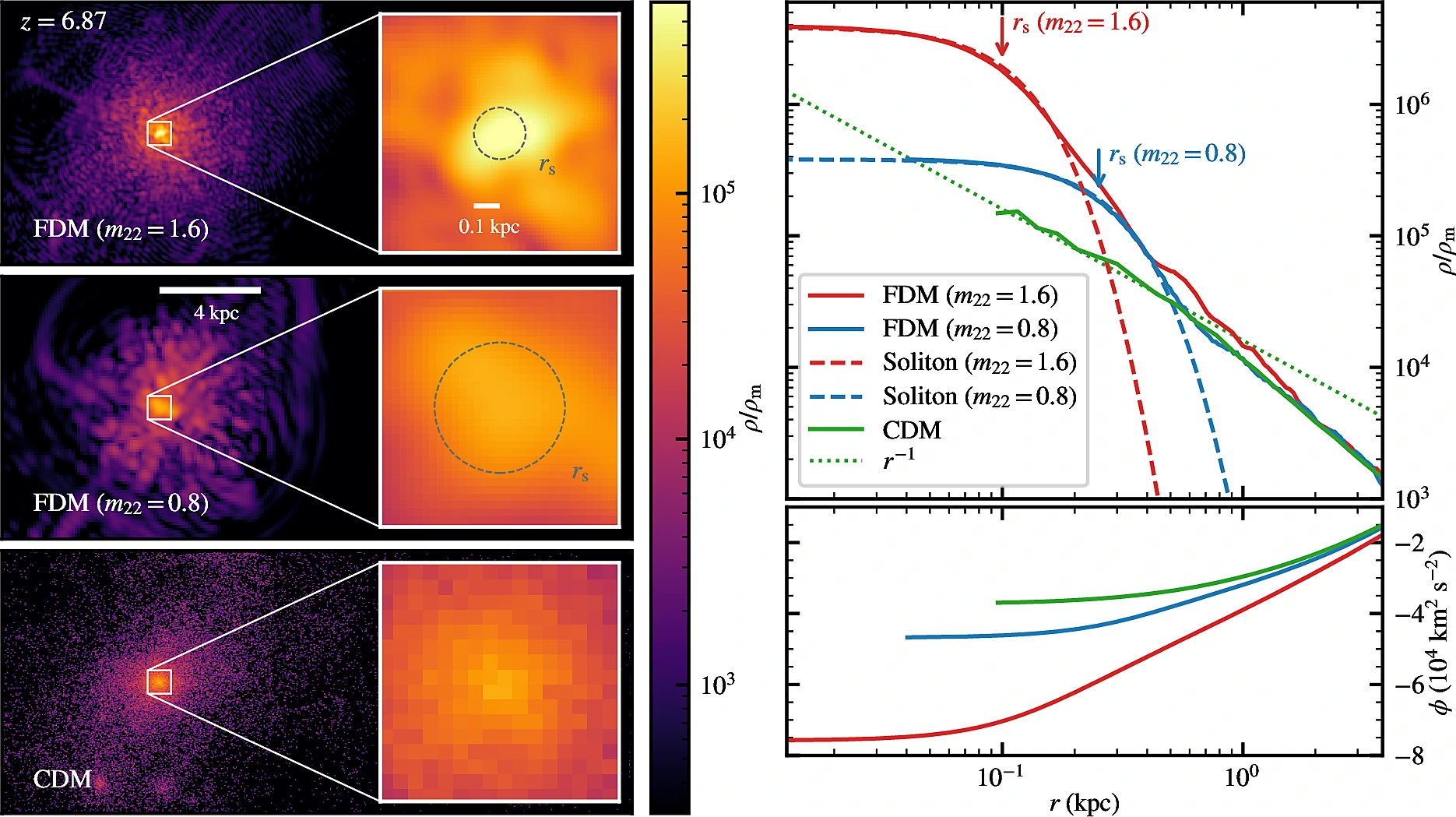
Boosting Supermassive Black Hole Growth in the Early Universe by Fuzzy Dark Matter Solitons
We demonstrate that ultradense fuzzy dark matter solitons, which naturally form at high redshifts with masses comparable to supermassive black holes (SMBHs), can drive rapid early SMBH growth. The soliton’s deep gravitational potential compresses the surrounding gas and triggers a two-stage accretion process that enhances the Bondi accretion rate by 2–4 orders of magnitude under efficient cooling. This mechanism offers a viable pathway for the formation of billion-solar-mass SMBHs within the first billion years of the Universe.